
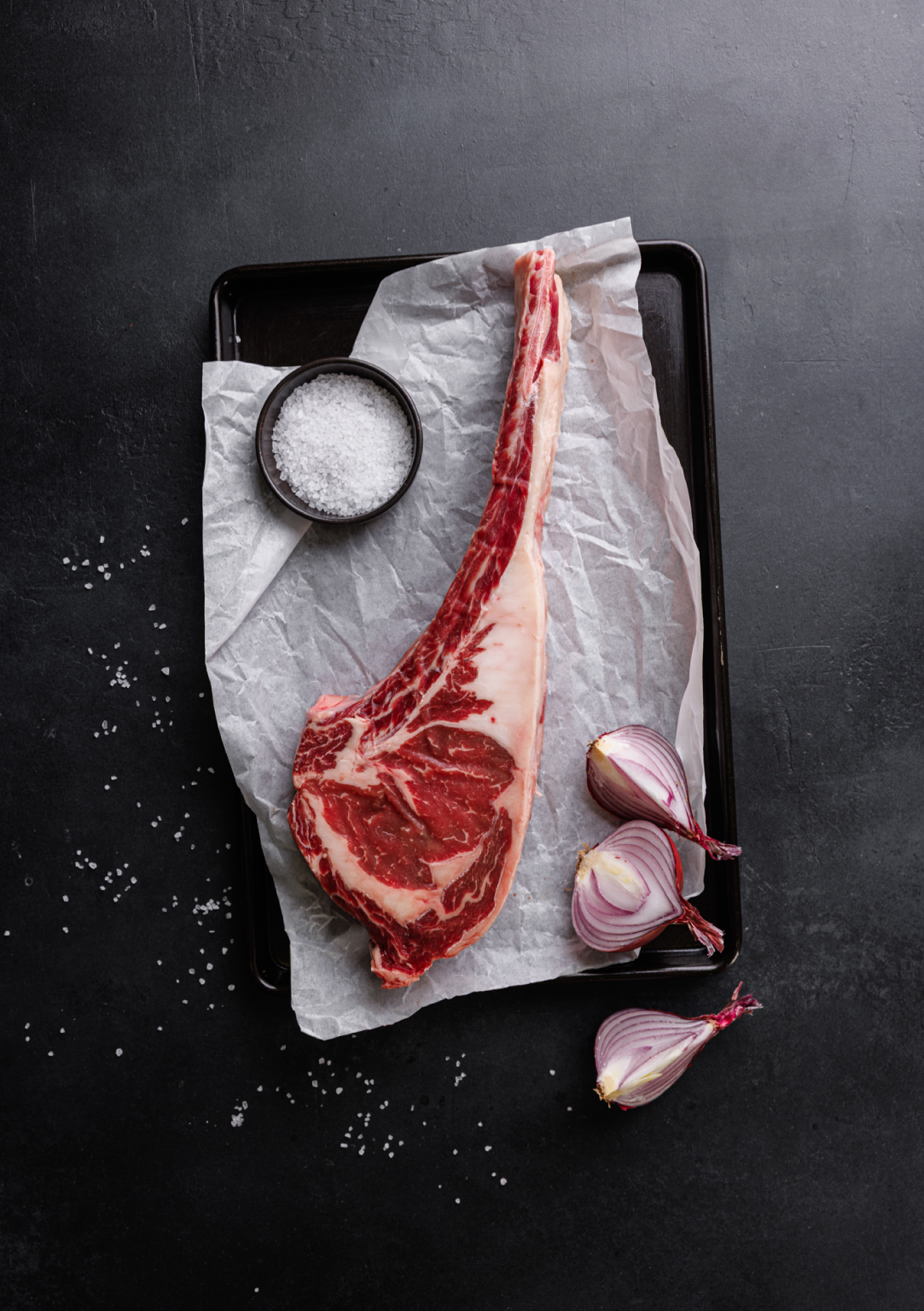
Nothing you can carry out of a kitchen gets the reaction a tomahawk does. A kilo of rib eye on a full length of bone looks like something from another century, and cooking one at home feels like an event before anyone has eaten a thing. The good news is that beneath the drama, a tomahawk is just a very thick rib eye, and thick steaks are actually more forgiving than thin ones once you know the method.
This guide covers the technique we recommend to every customer who buys one from us: the reverse sear. It also covers the barbecue version, resting, carving and the sides, so your tomahawk arrives at the table medium rare from edge to edge with a crust worth the occasion.
A tomahawk is a rib eye steak cut from the fore rib, with the entire rib bone left on, typically 13cm or more in length and trimmed clean so the exposed bone gives the cut its clear resemblance to a tomahawk axe. The bone is pure theatre, but the meat attached to it is serious: the same ribeye muscle prized for its marbling, usually cut 5cm or more thick and weighing 800g to 1.2kg, which helps give it a tender texture and buttery flavour. One tomahawk comfortably feeds two to three people, and its thickness is precisely why it needs a different approach from an ordinary steak.
Our halal Angus tomahawk is cut from HMC certified, grass-fed Angus beef and trimmed by hand in our Leicester cutting plant. If you want to take the occasion up another level, the halal wagyu tomahawk brings wagyu marbling to the same magnificent cut; we covered what makes wagyu special, and halal, in our guide to halal wagyu beef.
A little care at the ordering stage pays off at the table. Weight on a tomahawk includes the bone, so an 800g steak carries roughly 550 to 650g of meat; our 800g to 1kg cut is the sweet spot for two to three people. Look for even marbling across the eye of the meat, a creamy rather than yellow fat cap, and a steak cut to a consistent thickness so it cooks evenly, which is exactly what hand-cutting in our own plant guarantees for a juicy, buttery result.
Plan your timing backwards from dinner. If the steak arrives vacuum packed and frozen, give it a full 24 hours in the fridge to defrost; never force it in warm water. On the day, unwrap it an hour ahead, pat it dry, rub lightly with olive oil and let it come fully to room temperature. A damp, fridge-cold tomahawk is the single most common reason the sear falls flat.
One more decision worth knowing about: because the tomahawk is a rib eye at heart, it also exists in dry-aged form. Our dry-aged range includes bone-in rib cuts aged for weeks to concentrate their flavour, a genuinely different eating experience from fresh Angus and worth trying once you have mastered the method below.
Cook a 5cm steak the ordinary way, in a screaming pan from start to finish, and physics works against you. By the time the centre reaches medium rare, the outer couple of centimetres have blown past well done, leaving a grey band around a small pink core.
The reverse sear flips the order. You warm the steak through gently in a low oven first, bringing the whole interior evenly to just below your target temperature, then sear it hard and fast at the end for the crust. The result is a steak that is rosy from one edge to the other with a dark, crisp exterior, and because the surface is dry and warm when it hits the pan, the sear takes barely two minutes. It is also wonderfully low-stress: the slow stage is hands-off, and the steak will wait for you, not the other way round.
1. Temper and season. Take the steak out of the fridge a full hour before cooking; a cut this thick needs it. Pat every surface bone dry with kitchen paper and season generously all over with salt and pepper.
2. The slow stage. Heat the oven to 120°C (100°C fan). Sit the steak on the wire rack over a tray and slide it into the middle of the oven with the probe in the thickest part of the meat, not touching the bone. Cook until the core reaches 48 to 50°C for medium rare, which typically takes 45 to 75 minutes depending on thickness. For medium, take it to 54°C.
3. Rest briefly. Pull the steak, transfer it to a board and let it sit for 10 minutes while you get your pan smoking hot. Unlike a conventionally cooked steak, most of the resting work is already done, because the gentle oven never slammed the juices to the surface.
4. The sear. Put the pan over a high heat, then add a thin film of high smoke-point oil. Sear the steak 60 to 90 seconds a side, pressing gently so the whole surface makes contact, and stand it on its fat edge for a further minute. In the final minute, add a large knob of butter, two crushed garlic cloves and a sprig of rosemary, and baste continuously.
5. Serve almost immediately. A short rest of 5 minutes under loose foil is plenty. Aim for a final core temperature of 54 to 56°C for medium rare, or cook it a little further to your liking.
The same two-stage logic works over coals, and the smoke earns its place on the barbecue, or BBQ.
Set the barbecue for two zones, with coals banked to one side. Start the steak on the cool side over indirect heat, lid on, vents adjusted to hold roughly 120°C, and cook to the same internal temperatures as the oven method, turning halfway through. Then move it directly over the coals for the sear, a minute or two a side, watching for flare-ups as the fat renders. The bone makes a surprisingly practical handle for turning, with a glove on.
If barbecue beef is your happy place, our Angus beef back ribs and Korean-style short ribs belong on the same grill, and our guide to cooking brisket covers the long game.
Carving is half the point of this steak, so do it at the table and slice it onto a board or plate, depending on how you’re serving it. Run your knife along the bone to free the whole eye of meat in one piece, then slice the meat across the grain into strips the width of your thumb. Fan the slices out, scatter with flaky salt, then drizzle over any resting juices or melted butter, and lean the bone back against the board, because someone will want to pick it up, and the meat clinging to that bone is especially tender.
A tomahawk needs very little alongside, though it is rich enough that every bite benefits from something sharp: proper chips or our roasted garlic parmesan potatoes, a sharp green salad, and one good sauce. Our chimichurri recipe was practically made for it, and a creamy mushroom sauce is the classic alternative. Rich red meat, something sharp, something crisp; that is the whole formula.
If you love the idea but want options, three cuts sit in the same territory. The côte de boeuf is essentially the same rib eye on a shorter bone, slightly easier to manage in a home pan. The Angus porterhouse gives you two steaks in one, sirloin on one side of the T-bone and fillet on the other. And the T-bone is its slightly smaller sibling. All of them respond beautifully to the reverse sear; only the timings shift with thickness, which is exactly what the probe is for.
How long does a tomahawk steak take to cook?
Plan for about 90 minutes end to end: an hour of gentle oven time, a short rest, and a two to three minute sear. Thickness, not weight, drives the timing, which is why the thermometer matters more than the clock.
Can I cook a tomahawk in a normal oven and pan?
Yes. The reverse sear was designed for exactly that. The only genuine constraint is pan size; if the bone will not fit, let it hang over the edge and turn the steak with tongs, or sear on a griddle.
What temperature should a tomahawk steak be?
Pull it from the oven at 48 to 50°C and finish searing to a final 54 to 56°C for medium rare. For medium, pull at 54°C and finish at 58 to 60°C.
How many people does a tomahawk feed?
An 800g to 1kg tomahawk serves two to three once the bone is accounted for, carved and shared. For four, cook two and rest one while the other sears.
Is your tomahawk steak halal?
Yes, 100% HMC certified, like everything in our beef range. The meat is monitored from slaughter through our own cutting plant, so its halal status is never in doubt.
A steak this good starts long before the pan. Our tomahawks are cut from grass-fed Angus reared on UK and Irish farms, dry-handled by our butchers and vacuum packed fresh in Leicester. Order the Angus tomahawk or the wagyu tomahawk for nationwide delivery to your door, free locally over £60, or click and collect from Leicester Food Park.